
Gladys Eden
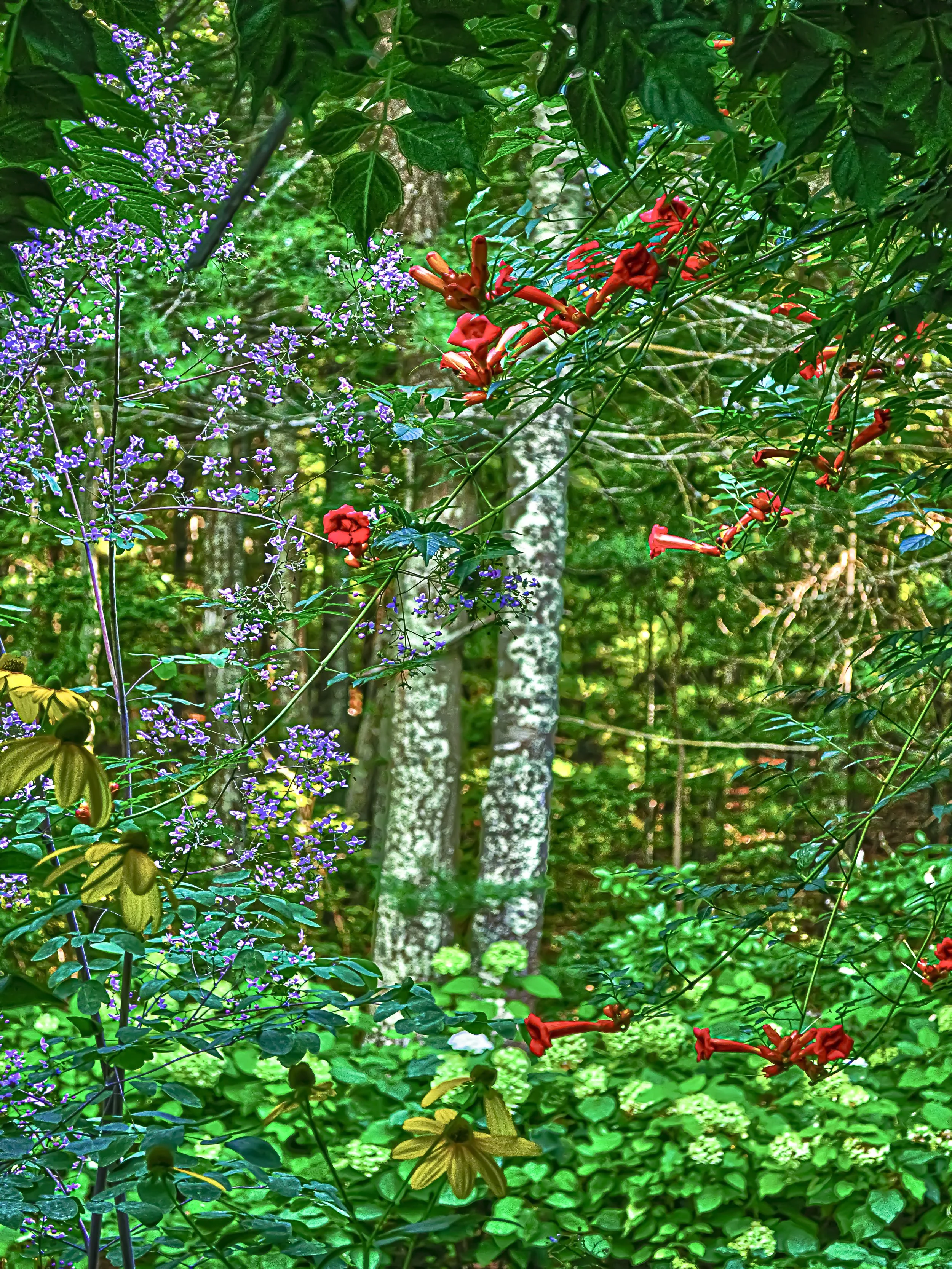
Built around a pergola, this intimate retreat has gradually disappeared beneath the generous advance of vegetation. Climbing vines, flowering branches, and luxuriant foliage weave together in layer upon layer, softening the garden's architectural framework until the distinction between cultivated space and the natural world nearly vanishes. The structure remains, but the plants have become its true architects.
What makes this garden extraordinary is its sheer abundance. Greenery fills the composition with an almost intoxicating density, creating a richly textured tapestry that rewards lingering attention. Leaves overlap, stems crisscross, and blossoms emerge from unexpected places. The eye wanders through this botanical profusion, discovering new details at every turn, as though entering a secret world that continues to reveal itself the longer one looks.
Then come the bursts of color: brilliant scarlet-red trumpet-shaped flowers reaching through the foliage, delicate sprays of violet blossoms dancing along slender stems, and occasional golden blooms glowing against the deep emerald greens. These vivid accents punctuate the surrounding vegetation with remarkable energy. Sunlight filters through the canopy, illuminating fragments of leaves and flowers while allowing deeper layers of greenery to recede into shadow. The resulting interplay of color, texture, light, and depth gives the scene an almost painterly intensity.
The garden's beauty lies precisely in its refusal to remain contained. This is not a portrait of formal symmetry or carefully controlled landscaping. It is a celebration of nature's exuberance—a place where vegetation has grown beyond convention, where abundance becomes the organizing principle, and where the garden seems less designed than discovered. The pergola provides the framework, but nature supplies the drama.
Named in honor of Gladys, the gardener and friend associated with this special place, Gladys Eden is also a quiet tribute to the human impulse to nurture living things and create spaces of refuge and wonder. Gladys Eden invites us to step beyond the idea of a garden as decoration and experience it instead as a living composition—abundant, unpredictable, vibrantly colored, and gloriously beyond convention.